Author: Faisal Tahir
Just because you are doing something anonymously on the internet doesn’t mean your information is private and vice versa. While the terms ‘privacy’ and ‘anonymity’ are often used interchangeably when discussing online security, they are completely different concepts and should be treated as such. In this blog post, we will explore the distinction between the two, and discuss which one is more important.
Anonymity safeguards your identity
Anonymity can be defined as the state of being unidentified. In the online world, it refers to keeping your identity separate from your actions while accessing the internet so that nobody knows who you are even if they can potentially see your web activity.
For example, you may use a pseudonym to create a social media account or post content anonymously on an online forum. While other users will likely not be able to discover your identity, they will have access to the information you share online.
Who needs online anonymity?
Online anonymity can be crucial for activists, whistleblowers, and victims of abuse.
How to achieve online anonymity?
Let’s look at some ways you can achieve anonymity in the digital world.
- Use a VPN: A VPN like PureVPN does more than hiding your IP address, it also protects your browsing history and encrypts your communication..
- Use a temporary email address: Creating a disposable email address for a social media platform or online forum can also help you maintain your anonymity for online security.
- Use an encrypted browser: Instead of using a regular browser, opt for a secure browser to shield your online activity from prying eyes.
Privacy safeguards your information
You likely don’t want scammers to gain access to your sensitive information when you access the banking app on your smartphone or purchase something through an online retailer. This is where online privacy comes into play. It refers to keeping your data and actions confidential without hiding your identity.
Online privacy is a fundamental human right as it keeps your personal data safe from misuse. The most common privacy issues on social media include identity theft, surveillance, and location tracking. However, with the right tools, you can strengthen your digital security without falling victim to a hacker.
Who needs online privacy?
In today’s digital world, every individual needs online privacy. After all, who would want others to see what website they visit or which posts they make on the internet.
How to achieve online privacy?
Here are some of the most effective tips for increasing your online privacy:
- Social privacy settings: One of the most common ways scammers gain access to your personal information is through social media. Customizing your privacy settings can give you complete control over who can see your posts.
- Create strong passwords: It may be tempting to use the same passwords for multiple social media accounts, but it is not a good practice and can potentially put your privacy at risk. Creating unique passwords can help improve your digital lifestyle.
- Enable two-factor authentication: Two-factor authentication has become essential for online security. It protects your social media accounts by asking for an authentication code or biometric verification instead of relying solely on password.
Which one is more important in today’s online world?
Anonymity and privacy are among the most crucial aspects of digital security. Nevertheless, if we are to compare the two, online privacy should be your top priority when accessing the internet. Everyone should be able to control who can view their full name, email address, phone number, banking details, and other personal information.
Meanwhile, anonymity can be just as important, especially if you have to share sensitive material or information online. However, it may not be as useful on a day-to-day basis as privacy.
Conclusion
Since social media tracking and data breaches have made online security a top concern, confusing the concepts of anonymity and privacy can put your digital lifestyle at risk.
-->Planning the most-awaited vacation break soon but are having cyberattack nightmares? Or want to explore new destinations, yet the personal data breach headlines keep spreading like wildfire in your mind at all times? We all love to travel with our best buddies – mobile phones – and a couple of other smart devices that let us enjoy every moment.
Unfortunately, these need to be recharged at the end of the day and that’s when we love taking advantage of free public charging ports, right? After all, no matter how extravagant a mobile phone we own on this planet – one thing is for sure – we need those cables to recharge it. Sad to say, but it happens too often that we are stuck somewhere with a dying smartphone battery and don’t think twice before plugging our phones into free public USB charging stations.
Read on as we uncover how these handy powering ports at hotel lobbies, airports, cafés and libraries become the number one silent cyberattackers. Along with how you can avoid falling prey to it.
Dilemma behind juice jacking
Phishing and malware attacks have never been easier than before – all it takes is a charging station with power connectivity and a cable. Many times, we juice up our devices at free USB charging stations, making us a victim of “juice jacking”. Nowadays, it’s become the most common cyber theft tactic to steal personal data and passwords through malicious malware. Hackers and other bad actors can easily exploit confidential information or track your keystrokes- raising concerns for online privacy and digital security, especially for content creators, tech junkies and business travelers.
That’s not all, even the FBI has published numerous warnings regarding juice jacking, recommending the public to stay safe.
Juice jacking made it into the wild
Juice jacking, a type of cyberattack, uses power data cables at USB charging ports to deliver unauthorized access to cyber criminals, allowing them to leverage illegitimate entry into your personal and private data.
Once your smart device is plugged-in and establishes a connection, hackers either secretly copy sensitive information or install malware. Juice jacking attacks could range from the simplest form of picture extraction to an invasive injection of malicious codes to extort financial value.
Generally, there are two types of digital security risks associated with Juice jacking:
Data breaches
Whenever we plug our smart devices into charging ports, it’s really hard to be sure that those cables haven’t been compromised. Apart from this, it has the potential to silently insert malignant software that infects your smart devices. As a result, hackers and cybercriminals gain access to the private and sensitive data saved in your mobile phones, enabling them to steal it.
They could also capitalize on it by using a crawler program, allowing them to search for financial and personally identifiable information. Can you even think of a time when a perpetrator has access to all your financial accounts?
Installing spyware
Another way through which hackers access phone data is through cloning malware, allowing them to gather sensitive information such as social security numbers, pictures, GPS location, social media credentials and so much more.
The common types of phishing and malware attacks used by cybercriminals in disrupting digital security include heavy usage of cryptominers, Trojans, ransomware and spyware. All of them have the power to freeze your mobile while extracting confidential information or demanding financial payment before restoring your phone.
Countermeasures to avoid juice jacking
Wondering if there is a way to protect oneself and not fall prey to it? Well, good news, there are simple tips that could safeguard you in the long run.
Plan ahead: The most obvious way to protect oneself is to avoid public charging ports at all costs. Make it a habit to charge your mobile phones, laptops, power banks and other devices in your car, at work or at home. Ultimately, it will reduce instances of a battery dying while traveling.
Carry a charger or power bank: Always bring your own “juice” by packing an extra battery in the form of an external charging device in your bag to keep off those malicious public power charging stations.
Opt for wall sockets: The best part is that there are no data transfers between your device and a regular wall AC outlet. So, at desperate times, always carry the correct adapter before leaving for your trip.
Conclusion
Juice jacking might not appear to be a major form of phishing and malware attacks, but it’s always a good idea to understand risks and alternatives before giving your battery a boost at free public charging stations.
-->Social media tracking has become an integral part of our daily lives, with social media platforms collecting data about our online behaviors, preferences, and interactions. While tracking can provide benefits such as personalized experiences and targeted advertising, it also raises ethical concerns about privacy, manipulation, and discrimination. In this blog post, we’ll explore how PurePrivacy adheres to the ethics of social media tracking and why it’s time for change.
Benefits and drawbacks of social media tracking
Social media tracking offers several benefits, including personalized recommendations, improved user experiences, and targeted advertising. By tracking user behavior and preferences, social media platforms can offer more relevant content and improve engagement. However, tracking can also have drawbacks. For example, it can be used to manipulate user behavior, such as by using persuasive design techniques to encourage addictive usage. Additionally, tracking can lead to discrimination and bias, as algorithms may make assumptions based on race, gender, or other characteristics.
The ethics of social media tracking
One of the primary ethical concerns with social media tracking is privacy. Users may not be aware of the extent to which their data is being collected and shared, or they may not have given informed consent for their data to be used in certain ways. Social media companies have been criticized for collecting data without transparency, and for using user data for purposes beyond what users may have anticipated.
PurePrivacy understands that manipulation of users is another ethical concern related to social media tracking. Companies can use tracking data to manipulate user behavior, such as by using notifications and push notifications to encourage more usage. Additionally, tracking data can be used to create personalized content that reinforces users’ beliefs and biases, leading to further polarization and division.
Discrimination and bias are also ethical concerns with social media tracking. Algorithms used in social media tracking may make assumptions based on race, gender, or other characteristics, leading to biased outcomes. For example, facial recognition technology has been found to be less accurate for people of color, leading to discriminatory outcomes in areas such as law enforcement.
The need for change
PurePrivacy is driving the narrative for a growing need for change in the ethics of social media tracking. Current regulations and oversight may not be adequate to address the potential harms of tracking. Additionally, there is increasing public awareness of the potential risks of social media tracking, leading to calls of change. Social media companies have a responsibility to promote ethical tracking and protect user privacy.
Potential solutions
Several solutions have been proposed to address the ethical concerns of social media tracking. These include:
- Improved transparency and consent: Social media companies can provide more information about how user data is being collected and used, and offer more options for users to control their data.
- Empowering users to control their data: Users can be given more control over how their data is used, including the ability to delete or limit the use of their data.
- Stronger regulations and oversight: Governments can enact stronger regulations and supervision to ensure that social media companies are using tracking data ethically and protecting user privacy.
Conclusion
Social media tracking raises important ethical concerns related to privacy, manipulation, and discrimination. While tracking can offer benefits such as personalized experiences and targeted advertising, it can also lead to potential harms. PurePrivacy remains committed to raising awareness of these concerns, however, there is a need for change in the way social media tracking is used and regulated. Social media companies have a responsibility to promote ethical tracking and protect user privacy. By implementing solutions such as improved transparency and consent, empowering users to control their data, and stronger regulations and oversight, we can promote ethical social media tracking and ensure that users are protected.
Social media has become an essential part of our lives, with billions of people using various platforms to connect, share, and engage in different online activities. While social media can be a useful tool, concerns about privacy and security have become increasingly prevalent. In this blog post, we will explore the psychology of social media privacy, why PurePrivacy cares about it, and what we, as users, can do to protect ourselves.
Why do we care about social media privacy?
The desire for privacy is a fundamental human need. We all have aspects of our lives that we prefer to keep private and only share with a select few. With social media, however, the lines between private and public can become blurred, and we can feel like our personal information is being exposed to the entire world. Pure Privacy ensures there is no loss of control of personal information and prevents feelings of vulnerability, anxiety, and mistrust.
Another reason why social media privacy is important is because of the potential consequences of data breaches. If our personal information falls into the wrong hands, it can be used for identity theft, fraud, and other malicious activities. This can have serious implications for our financial security, reputation, and even physical safety.
What can we do to protect our social media privacy?
The good news is that there are several steps we can take to protect our social media privacy. Here are some of the most effective ones:
1. Review your privacy settings:
Social media platforms allow users to customize their privacy settings to control who can see their posts, profile information, and other content. With an app like PurePrivacy, take ample time to review and adjust these settings to ensure that your information is only visible to those you trust.
2. Review your privacy settings:
Social media platforms allow users to customize their privacy settings to control who can see their posts, profile information, and other content. With an app like PurePrivacy, take ample time to review and adjust these settings to ensure that your information is only visible to those you trust.
3. Use strong passwords:
One of the most common ways that hackers gain access to social media accounts is through weak passwords. Pure Privacy allows you to use a combination of letters, numbers, and symbols to create a strong password that is difficult to guess.
4. Avoid phishing scams:
Phishing scams are a common way for hackers to steal personal information. Be wary of emails or messages that ask for your login credentials or other sensitive information. If in doubt, contact the social media platform directly to verify the legitimacy of the request.
5. Use two-factor authentication:
Two-factor authentication is an extra layer of security that requires users to enter a code sent to their phone or email in addition to their password. This can make it much more difficult for hackers to gain access to your account.
Conclusion
In conclusion, social media privacy is a complex issue that requires careful consideration. PurePrivacy understands the psychology of online privacy and has taken steps to protect the personal information of our users, so they can enjoy the benefits of social media without sacrificing their privacy and security.
Tax season can be a stressful time for many people, especially those who are filing their taxes for the first time. However, even seasoned filers can make mistakes that could potentially cost them time and money. To help you avoid these pitfalls, we’ve compiled a list of the top 5 common tax filing mistakes that you need to avoid.
1. Filing late or not filing at all
One of the most common mistakes people make is simply not filing their taxes on time. If you don’t file your taxes by the deadline, you could be hit with late filing fees and penalties. If you owe taxes and don’t file on time, you may also face interest charges on the amount you owe.
To avoid this mistake, make sure you mark the tax deadline on your calendar and give yourself plenty of time to prepare and file your taxes. If you’re having trouble filing on time, you may be able to request an extension, but keep in mind that this will only give you more time to file, not more time to pay any taxes you owe.
2. Incorrect personal information
Another common mistake people make when filing their taxes is providing incorrect personal information. This includes things like your name, Social Security number, and address. Providing incorrect information can lead to delays in processing your return, and in some cases, it can even trigger an audit.
To avoid this mistake, double-check all of your personal information before you submit your tax return. Make sure your name and Social Security number match your official documents, and that your address is up-to-date.
3. Failing to report all income
It’s important to report all of your income when filing your taxes, including income from freelance work, rental properties, and investment income. Failing to report all of your income can lead to penalties and interest charges, and in some cases, it can even lead to an audit.
To avoid this mistake, make sure you keep accurate records of all of your income throughout the year. Don’t forget to report any income you receive from side jobs, freelance work, or other sources outside of your main job.
4. Failing to claim deductions and credits
One of the biggest mistakes people make when filing their taxes is failing to claim all of the deductions and credits they’re eligible for. Deductions and credits can help reduce your tax bill and increase your refund, so it’s important to take advantage of them.
To avoid this mistake, make sure you research all of the deductions and credits you’re eligible for before you file your taxes. Some common deductions and credits include the Earned Income Tax Credit, the Child Tax Credit, and deductions for charitable donations and medical expenses.
5. Filling the wrong form
Finally, another common mistake people make is filing the wrong tax forms. There are many different tax forms, each with its own purpose, and it’s important to make sure you’re using the correct form for your situation.
To avoid this mistake, make sure you understand which tax forms you need to file based on your income, deductions, and credits. You can also consult with a tax professional or use tax preparation software to make sure you’re using the correct forms.
Conclusion
In conclusion, filing your taxes correctly can be a daunting task, but avoiding these common mistakes can make the process much smoother. Make sure you’re filing on time, providing accurate personal information, reporting all of your income, claiming all of the deductions and credits you’re eligible for, and using the correct tax forms. By doing so, you can avoid penalties and interest charges, and make sure your tax return is processed correctly and efficiently.
-->April Fools’ Day is known for its playful pranks and harmless hoaxes. Unfortunately, cybercriminals also take advantage of this day to launch their own scams, which can cause significant harm to unsuspecting victims. Here are some of the cyber scams you should watch out for on April Fools’ Day:
1. Phishing scams
Phishing scams are one of the most prevalent cyber scams and typically involve tricking individuals into revealing their personal information such as login credentials, bank details, or social security numbers. Scammers will often use fake emails or social media messages that appear legitimate, often containing a sense of urgency to make you act quickly. Always double-check the sender’s email address and look out for any spelling errors or suspicious attachments before clicking on any links or providing any personal information.
2. Fake giveaways
Be wary of any emails or messages offering free products or services, especially if they require you to provide personal information or payment details. Cybercriminals often use fake giveaways to trick people into giving away their personal information or downloading malware onto their device.
3. Malware attacks
Malware is software that’s designed to harm your computer or steal your personal information. Scammers may use April Fools’ Day as an opportunity to distribute malware through fake websites, emails, or downloads. Always use anti-virus software and be careful when downloading anything from the internet.
4. Social media scams
Social media is another common platform for scammers to target unsuspecting users. They may create fake profiles or pages to promote fraudulent offers or spread malware. Be careful when clicking on links or downloading attachments from social media and always verify the source before engaging with any content.
5. Tech support scams
Tech support scams involve a scammer pretending to be a tech support representative and offering to fix an issue with your computer or device. They may try to convince you to give them remote access to your computer or pay for fake software. Be wary of unsolicited calls or messages from tech support representatives, and never give out your personal information over the phone or internet.
Conclusion
In short, while April Fools’ Day can be a fun time for harmless pranks and jokes, it’s important to stay vigilant and aware of potential cyber scams. By being cautious and verifying the source of any messages or promotions, you can help protect yourself from falling victim to these scams. Stay safe and have a happy April Fools’ Day!
Happy April Fool’s Day, internet friends! As a VPN company, we thought we’d celebrate the occasion by sharing some of the most ridiculous, unbelievable, and downright hilarious online security myths out there.
Myth #1: VPNs are for spies and criminals.
Believe it or not, some people still think that VPNs are only used by spies and criminals. While it’s true that VPNs can be used to hide your online activity, the reality is that they’re also used by millions of law-abiding citizens around the world who value their online privacy.
Myth #2: VPNs are illegal.
Nope! VPNs are perfectly legal in most countries. In fact, many businesses use VPNs to secure their online communications and protect their sensitive data from cyber attacks.
Myth #3: VPNs slow down your internet connection.
While it’s true that some VPNs can slow down your internet connection, the best VPNs actually improve your online speed and performance by reducing lag and buffering.
Myth #4: VPNs can protect you from everything.
As much as we’d love to say that VPNs can protect you from everything, the truth is that they’re not a magic bullet. While VPNs can certainly help protect your online privacy and security, they can’t protect you from every type of cyber threat out there.
Myth #5: VPNs can teleport you to another country.
We wish! While VPNs can make it appear as if you’re browsing from another country, they can’t actually teleport you there. If only we had that technology!
So, there you have it – some of the most ridiculous online security myths out there. As a VPN company, we’re here to help you stay safe and secure online, no matter what day of the year it is. Happy April Fool’s Day, and stay safe out there!
In today’s digital age, data has become a critical component of our lives. From personal photos and videos to important business documents, our digital information is irreplaceable. Yet, many people fail to back up their data regularly, leading to potential loss and destruction. In this blog, we will share four horror stories of people and organizations who did not back up their data and the consequences they faced.
Horror story # 1: The Toy Story 2 nightmare
In 1998, Pixar was working on the movie Toy Story 2 when one of their animators accidentally entered a command that caused the deletion of nearly all the movie’s digital files. The team had not made a backup of the data for a few months, and it seemed like they had lost everything. However, an employee who was working from home had made a backup copy of the data, which saved the movie. This incident demonstrates the importance of having multiple backups of your data in case one backup fails.
The fact that the entire movie was restored from a single computer is a testament to the power of backups and the importance of having a disaster recovery plan in place.
Read the full story here
Horror story # 2: T-Mobile data breach
In August 2021, T-Mobile, a mobile network operator, experienced a data breach that affected over 50 million customers. The breach resulted in the theft of personal information, including names, dates of birth, social security numbers, and driver’s license information. The incident once again highlighted the importance of securing customer data and the consequences of not doing so.
Read a full account here.
Horror story # 3: Colonial Pipeline ransomware attack
In May 2021, Colonial Pipeline, a major US fuel pipeline operator, experienced a ransomware attack that resulted in the shutdown of the pipeline. The attack caused significant disruption in fuel supply and resulted in a loss of data, including critical business data. The incident highlighted the importance of securing critical infrastructure and the consequences of not doing so.
Read more here.
Horror story #4: The Equifax data breach
In 2017, Equifax, a credit reporting agency, experienced a data breach that affected over 147 million people. The breach occurred because Equifax had not updated their software and failed to patch a known security vulnerability. This incident highlights the importance of keeping your software up-to-date and securing your data with the latest security measures.
Full account here.
Conclusion
These horror stories demonstrate the importance of backing up data regularly and having multiple backups in case one fails. They also highlight the importance of securing your data with the latest security measures and having strong IT processes and procedures in place to prevent human errors that can lead to data loss. Taking proactive steps to protect your data can help prevent potential loss and destruction.
Description: Facts, stats, and data on the rising incidents of sexual harassment and violence women face on the internet every day
Throughout history, the world has been unkind to women.
Mankind’s progress with new technology and inventions have not changed this sad reality. In fact, only the methods of harassment have mutated and metastasized with the times. Incidents of domestic violence, workplace harassment, and street-based harassment now have to contend with a new monster – online harassment.
Harassment in public and private spaces
Living in constant fear of stalking, staring and ogling, catcalling, inappropriate contact and remarks of sexual nature, particularly from men. For something as simple as walking down the street.
This is what it’s like for the women every day. Everyone has a story.
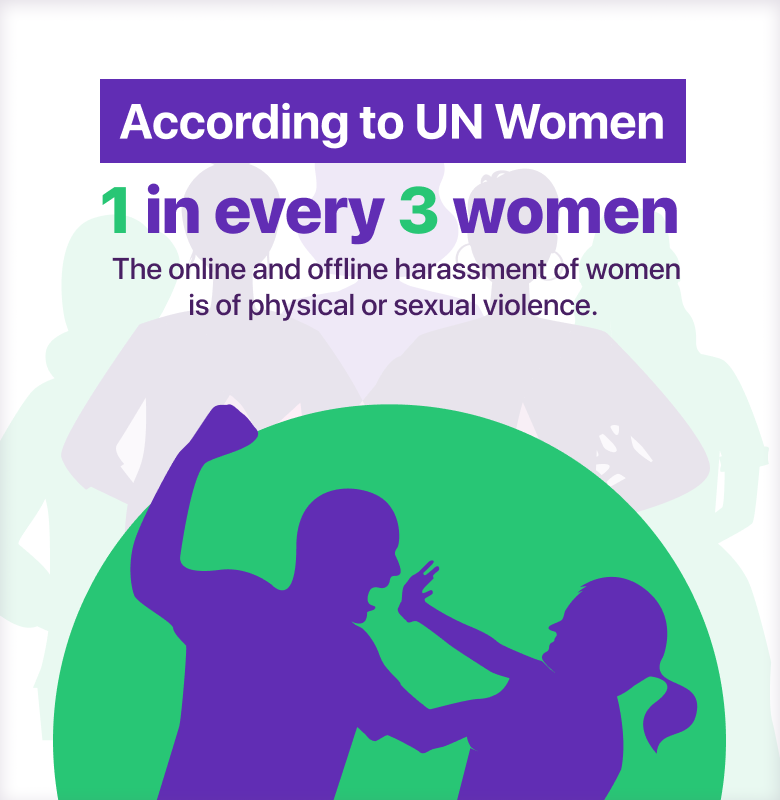
“Whether at home, on the streets or during war, violence against women and girls is a human rights violation of pandemic proportions that takes place in public and private spaces,” they state.
“In the Middle East and North Africa, 40-60% women have experienced sexual harassment while walking down streets. 44% of women in India have been groped in public. In Bangladesh, this figure climbs to a horrifying 84%.”
In the US, about 65% of the women experienced sexual harassment on the street.
It’s a sad commentary on our state of affairs since men don’t have to worry much about being catcalled or hounded off the streets. This is not to say they don’t face it at all, only that this ugly and incisive kind of ire is specifically reserved for women.
Harassment of women in online spaces
The internet and social media were conceived to make information sharing more democratic and open. While it has it’s good points, it’s becoming increasingly overshadowed by it’s dark side, one being the rise in online harassment against women.
Raise your hand if you have heard of terms like revenge porn, unsolicited pictures, deep fakes before 2010. Probably not, right? There’s a good reason why you heard of them only very recently.
These are all new-age crimes that were conceived to target women online.
Let the numbers speak for themselves:
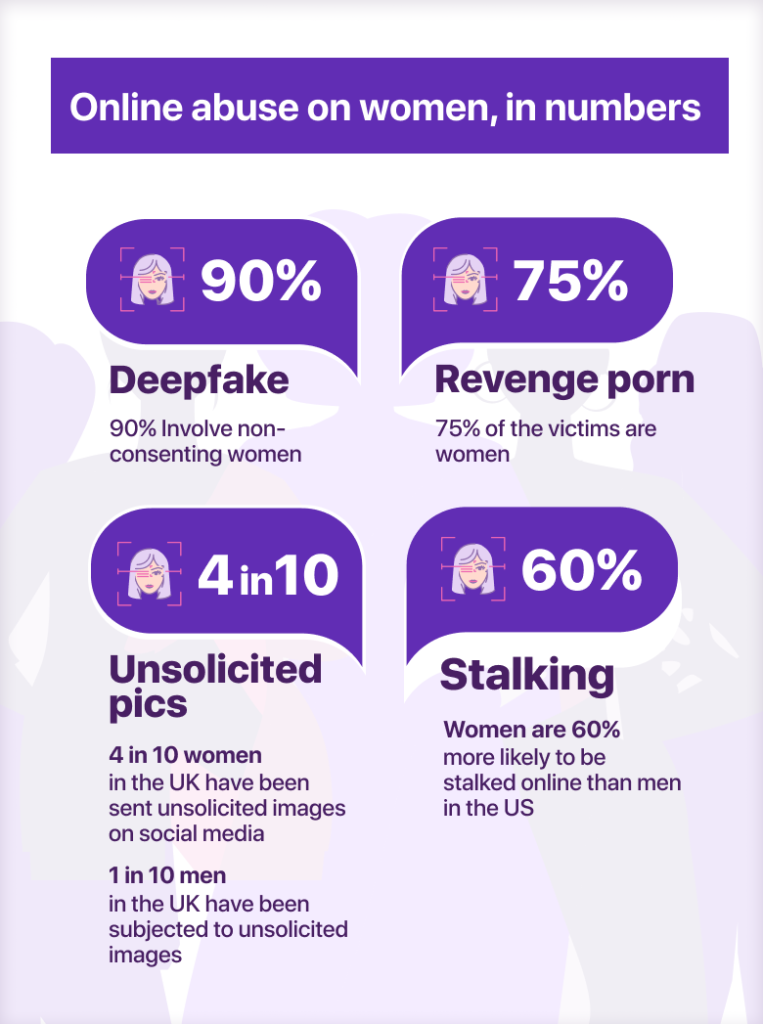
What about social media? These platforms are not kind to women globally, and not enough is being done to make people feel safe online.
Here are some alarming stats from 2017 that targeted women:
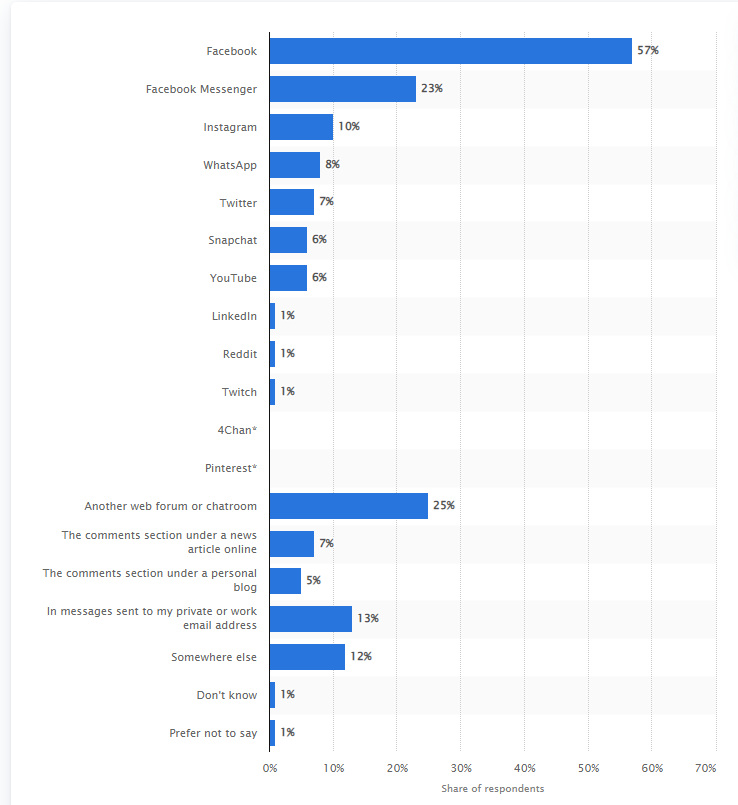
Via Statista.com
How online harassment is gendered
Men need to be aware of an ugly truth. The level of harassment that women face online and offline is astronomically different from what men usually face.
Both on a qualitative and quantitative level, women have it worse. and here’s why: When men are harassed, it is usually done with the intent of shaming and embarrassing them.
When it comes to women, they are insulted, stalked, harassed and shamed online by trolls and perverts with a particular focus on their gender. The vitriol they experience is sexist, followed by threats of offline violence if they do not respond to their harassers.
It is not unusual for women to face threats of extortion, doxing, rape, even murder from random accounts or phone numbers.
Here is why men need to learn that women who share their horrible experiences should not be gaslighted or dismissed as ‘hysterical’:
- Imagine being a woman who has no option but to constantly look over her shoulder. They are frequently harassed both online and offline, and as a consequence, need to be hyper-vigilant at all times. It’s exhausting, draining, and stressful. Imagine living in fear of what’s around the corner. That’s how it is.
- When women are targeted over their gender, abuses and threats of a personal nature are not far off. Women from every background and culture are summarily targeted due to their race, sexuality, disability, or faith.
- Women still have to deal with sexist and patriarchal constraints. These factors limit women from working, enjoying fundamental constitutional rights, joining politics, and so on. These limits do not extend to men. These issues are not only limited to culture but also laws that discriminate against people on the basis of their gender.
- The objectification and dehumanization of women has become mainstream. Advertising, mass media, popular culture – it has seeped into every facet of our lives. Women are merely viewed as objects, not human beings.
Why is it easy for harassers to subject women to abuses so vile? The anonymity afforded by the internet to harassers is part of the reason. A belief that you can get away with it, while sitting behind a keyboard or smartphone from any corner of the world.
Not all men? It’s time for the men to do better
The point of these statistics and data is to educate the people in our life, especially men. The proliferation of smartphones and social media platforms have given birth to more depraved forms of harassment.
A change in mindset is not only required, but the need of the hour.
Here’s how men can help slowly make spaces safer for women.
When a woman confides in you, believe her the first time.
When a woman confides in you, believe her the first time.
Give her the benefit of doubt.
Reassure her.
Be mindful of cultural and personal sensitivities. Uphold her trust.
Involve the authorities if need be.
Be supportive.
As a victim, she needs your understanding and empathy, not blame.
It is time to #BelieveHer and combat online harassment. It is time to listen to her and be there. Talk to your peers, coworkers, and other stakeholders about the need for safe spaces and equal opportunities for women. It is doable, but it will take a collective effort from everyone to get there.
#RingTheAlarm
Description: This #InternationalWomensDay, we’re discussing ways women can protect themselves from online harassment
Cybercrime is a serious issue that impacts everyone, but it can be especially daunting for women. According to recent statistics, cybercrime is a bigger problem for women than it is for men. In fact, women are almost twice as likely to be victims of cybercrime, which includes cyberbullying, cyberstalking, and online sexual harassment.
Living in the current digital age, there are numerous ways for women to stay protected online. We have decided to do our bit by shedding light on some basic principles that increase women’s online protection from such threats.
1. Make use of a VPN more rampant
As you may be aware, the role of a Virtual Private Network (VPN) holds more significance than ever in today’s time, and for good reason. You can create a secure connection between your device and the internet with a premium VPN service. That will encrypt your data and protect it against any looming dangers like cybercrime or snoopers, giving you peace of mind and a secure online experience.
2. Use a password manager
Another way to stay safe online is by using a password manager. This tool stores your passwords in a secure database, so you don’t have to remember them all by yourself. This makes it harder for hackers to steal your information, thus protecting your privacy.
3. Steer clear of public WiFi
Always be wary of using public WiFi networks. There are too many risks involved as they are not secure and open for hackers. So why make it easy for them to steal your data? Steer clear from the headache and always use a VPN or a password manager when traveling.
4. Change your passwords frequently
As cyber theft is growing and becoming more common by the day, it’s important to be aware of phishing scams or malware. Always bear in mind to never give out personal information such as passwords or credit card numbers. Moreover, install security software on your computer in order to protect your privacy and keep the data safe.
5. Avoid clicking on random links
Always be super cautious about the websites you visit and the links you click on. Simply avoid opening attachments or downloading files from unknown sources. This way, you’ll be able to maintain your privacy and circumvent unforeseen dangers.
6. Beware of social media scams
Scammers often use social media platforms to try and scam people out of their money or personal information. Again, be careful about the links you click on, and be suspicious of any offers that seem too good to be true
7. Google yourself
It’s always a risk sharing your personal life in the public sphere. But to have better control over it, we advise you to Google your name and gauge from the results you encounter. That will give you a better idea of what it’s like to share stuff and how easily a piece of information could fall in the wrong hands.
8. Set your account to private
You can set your account to private, and only share information with people that you trust. You can also use encryption tools to protect your communications and regularly delete your cookies and browsing history.
9. Be careful on dating apps
We understand the hype surrounding various dating apps is real but it’s better to be safe than sorry. There’s nothing wrong with the prospect of meeting someone new, you are in full control of what you share, and you should do it wisely. Make sure you don’t share too many details, like where you live and so on, with someone you’ve just met online. If you decide to meet someone in person, make sure you inform a friend or close one about it. After all, you wouldn’t want the first encounter turning nightmarish, much against your expectations.
10. Don’t hesitate to reach out for help
It’s never a good idea to suffer in silence and best to reach out to someone. Women can seek help from support organizations, such as Women’s Aid. These organizations can provide victims with practical and emotional support and can help them to access legal advice and assistance.
It’s important to remember that nothing is 100% safe online. No matter how careful you are, there’s always the unexpected. The best way to stay protected is to be vigilant and aware of the dangers that exist and play your part to create a safe and secure online world.